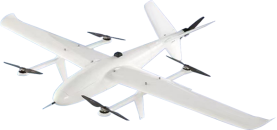
Product features
Vertical take-off and landing capability, which greatly reduces the requirements for take-off and landing sites
The power redundancy design provides a solid guarantee for the overall flight safety of the aircraft.
Its system structure is compact and does not require complex auxiliary equipment. Transportation, deployment, maintenance and recycling all become simple.
The integrated special flight control and navigation system enables fully autonomous flight.
Product parameters
|
FY-02 parameters
|
|
Size
|
2.5m*1.26m*0.39m
|
|
Task warehouse size
|
260mm*172mm*135mm
|
|
Battery compartment size
|
260mm*150mm*85mm
|
|
Fuselage length
|
1.26m
|
|
Wingspan
|
2.5m
|
|
Landing gear height
|
195mm
|
|
Takeoff weight
|
≤14kg
|
|
Standard no-load takeoff weight
|
Around 11.5kg
|
|
Load capacity
|
≤2.5kg
|
|
Sailing without load
|
240min
|
|
Cruising speed
|
20m/s
|
|
Maximum altitude
|
4800m
|
|
Wind resistance performance
|
Rotor Mode Level 6
|
|
Fixed Wing Mode Level 7
|
|
Protection grade
|
IP54
|
|
Take-off and landing mode
|
Vertical take-off and landing
|
|
Power mode
|
Battery
|
|
Battery life
|
3.67h@1kg load (measured near sea level in a calm wind)
|
|
Maximum control distance
|
The remote control can be manually controlled for approximately 0.5 to 1 kilometer
|
|
The ground station controls the distance from 5 kilometers to 30 kilometers
|
|
Standard cruising speed
|
20m/s @12.5kg
|
|
For mountainous area operations, 21m/s@12.5kg is recommended
|
|
Maximum cruising speed
|
93.6km/h(26m/s)
|
|
Standard battery configuration
|
22.8V/25Ah*2(45.6V)
|
|
Never exceed the speed
|
122km/h(around 34m/s)
|
|
Stall speed
|
15.5m/s@12.5kg
|
|
Minimum circling radius
|
120m@19m/s
|
|
The safe turning radius on the plateau shall not be less than 200 meters
|
|
Usage environment
|
-20℃~45℃
|
|
It can fly in light rain (safe operation time > 10 minutes
|
|
Emergency operation time of the rotor
|
≥6.5min
|
|
When the rotor battery is independently powered (non-standard power configuration)
|
|
Dimensions of the vertical power paddle blades
|
16/17inch
|
|
Fixed wing tail propeller blades
|
15~18inch
|
|
High-altitude performance
|
Pass the high-altitude test
|
|
The above parameters are for reference only. The detailed product parameters are subject to the actual delivery.
|
Drone Safety Tips
General weather information
The main meteorological conditions that seriously affect the flight of unmanned aerial vehicles are:
Heavy rainfall weather, which may be accompanied by lightning and hail attacks, wind shear and turbulence, affects the aerodynamic performance of aircraft
Deterioration, excessive load on the motor, and even burnout.
Ice accumulation on aircraft mainly falls into three categories: ice, rime ice and frost. Mild icing may affect the performance of aircraft.
If ice does not accumulate, the flight can continue, but the flight time will be significantly reduced. If the aircraft reaches moderate or severe icing, it should immediately change course or land.
Visibility: When the effective visibility at the flight site is too poor, aircraft are prohibited from flying.
When encountering visual range obstacles during flight, that is, visual range obstacle weather, one should change flight and land as soon as possible to avoid unnecessary consequences loss.
Mountain air currents. The main impact of mountain air currents on aircraft is the effect of vortices. When flying in mountainous areas, the safety of the flight path should be enhanced
Height, pay attention to the mountain air current.
Wind shear occurs. The wind direction in mountainous areas varies greatly. Attention must be paid to the wind conditions at the time of takeoff, flight path and landing.
Battery Capacity Saving Program
Ensure that the flight controller software version is the latest version.
Before takeoff, adjust the aircraft parameters based on the takeoff weight and adjust the flight speed according to the manufacturer's guidance and suggestions.
Reduce rapid maneuvers, minimize hovering time in the air, and reduce crosswind operation time for aircraft.
Reduce high-altitude operation time.
Please use the battery temperature management system in high-altitude areas.
High altitude operation (2438 meters and above)
When drones operate at high altitudes, the power system load is large, which may cause the aircraft power system to overload and burn out the electric motor. It is recommended to ensure that the aircraft operates at a safe altitude. If operating at high altitudes, reduce the load weight and operating time, lower the aircraft climb and descent rate, increase the turning radius, and reduce or prohibit large maneuvers.
Regarding power loss: During high-altitude operation, both the electric and hydraulic systems will experience partial power loss due to thin air and reduced atmospheric content, thereby reducing the maximum takeoff weight and standard endurance of the aircraft. Replacing the corresponding propeller can reduce some power loss.
Regarding electronic devices: Some electronic devices are more prone to corona and discharge phenomena when operating at high altitudes. Please carefully check the relevant electronic devices during high-altitude operation.
Regarding electronic devices: Some electronic devices are more prone to corona and discharge phenomena when operating at high altitudes. Please carefully check the relevant electronic devices during high-altitude operation.
Regarding weather information: Highland airports are located at high altitudes, and due to the usually strong winds at high altitudes, the air near the ground is unevenly heated in the sunny and shady directions by the sun. In addition, the terrain blocks and accelerates the wind, resulting in frequent strong winds and significant changes in wind speed and direction, which can easily lead to turbulence, turbulence, and wind shear. Please pay attention to turbulence and wind shear during takeoff and landing. At the same time, attention should be paid to the complex and variable plateau climate, obvious time differences, regional and local characteristics. Please pay attention to the departure time and climate conditions.
Regarding terrain: Some high-altitude terrains are mountainous, with many canyons and cliffs. The communication antenna system of unmanned aerial vehicle data transmission links often adopts vertical polarization and horizontal polarization polarization, which may cause multi-path interference due to the influence of terrain, and may shorten communication distance and reduce communication quality.
Regarding low-temperature operation: Cold weather operation mainly affects the battery discharge capacity and flight control sensor components of the aircraft. When the operating temperature of the battery is below 10 degrees Celsius, the battery discharge curve will significantly deteriorate, leading to a sudden drop in voltage without warning, which may cause the aircraft to lose power supply. When the temperature is low, it can also affect the malfunction of flight control related sensors, thereby affecting the safe flight of the aircraft. Please use the heating system when operating at high altitude. Aircraft are prohibited from flying at extremely low temperatures.
Regarding operators: The battery life of electronic devices related to high-altitude operation is reduced, and the quick reaction ability of personnel may be reduced to varying degrees due to less oxygen and lower temperatures. Please pay attention to personnel coordination during high-altitude operation.
Note: When operating at high altitude, please replace the corresponding propeller model according to the operating altitude (contact our company for specific technical parameters).
Cold weather operation
Cold weather operation mainly affects the endurance of aircraft. When the temperature is below 10 degrees Celsius, the operation time of the aircraft will significantly decrease and the battery discharge curve will significantly deteriorate, resulting in a sudden drop in voltage without warning and causing the aircraft to lose power. Therefore, takeoff aircraft should be reduced or prohibited during low temperature weather.
When operating in cold weather, sponge or foam can be added in the gap between the battery and the engine body to significantly improve the battery discharge curve in cold conditions and extend the aircraft operation time.
When transporting batteries, please use insulated battery explosion-proof boxes for transportation.
When calibrating airspeed, please pay attention to whether the pressure sensor and altitude sensor are abnormal.
Note: The battery heating module provided by our company can be selected as needed for operation in cold weather.
Precautions for Solid State Battery Operation
The new battery can increase the hovering time of this model of aircraft, but there are several things you must know before using it:
The power configuration is different from the standard configuration and is not compatible with the standard power battery. Please contact our company if needed.
Operate below an altitude of 1500m.
Run with a load not exceeding 1kg.
The temperature of the data testing environment is greater than 15 degrees Celsius.
The takeoff and landing site operates with wind speeds below level 3.